What is Yi Jing?
Yi Jing, commonly known as Book of Changes (or Classic of Changes), one of humanity’s oldest philosophical and divinatory works. As a divination tool, the Yi Jing serves as a mirror to both the unconscious mind and the wider universe. Through the symbolic language of its hexagrams, this ancient system offers a way to find clarity when navigating difficult problems and challenging life situations.
Why Use It?
Personal Growth Aspect
With awareness and practice, Yi Jing divination can become a guide for insight for you. In ancient times, practitioners honed this skill through many experiences and connection with the universe, using all their sensory perceptions such as sight and sound. With the same approach, you can grow and sharpen your awareness too.
- Intuitive
- Creative
- Logical
- Observant
- Clarity
- Neutral & Unbiased
Quick Facts
- Dated back over 5,000 years
- Originated in ancient China
- Lines are either Yin or Yang
- Made up of 64 hexagrams
- Each hexagram has six lines (known as Yao)
- Lines are read from bottom to top
- Influenced Confucianism and Daoism
- Hexagrams reflect movement, change and transition
Getting a Divination using Yi Jing in 4 Steps
Step 01
Step 02
Step 03
Step 04
A Yi Jing divination unfolds through four essential steps. Although these steps are concise, each involves careful attention and understanding. Readers who wish to explore the process in greater depth may refer to Yi Jing Decoded by Dean Chua, which offers a detailed explanation of each step and their practical use.
Simple Divination Method
The Date-Time Approach
Step 01: Determine & Combine the Date and Time
Get ready the digits from the dd/mm/yyyy + XXXX (in 24-hour format)
Step 02: Determine the Upper Trigram
Using the dd/mm/yyyy, Add all the numbers together: d+d+m+m+y+y+y+y
The result will then be modulo by 8= The remainder digit will be your A.
Step 03: Determine the Lower Trigram
Using the dd/mm/yyyy, XXXX, Add all the numbers together: d+d+m+m+y+y+y+y+x+x+x+x
The result will then be modulo by 8= The remainder digit will be your B.
Step 04: Form the Hexagram
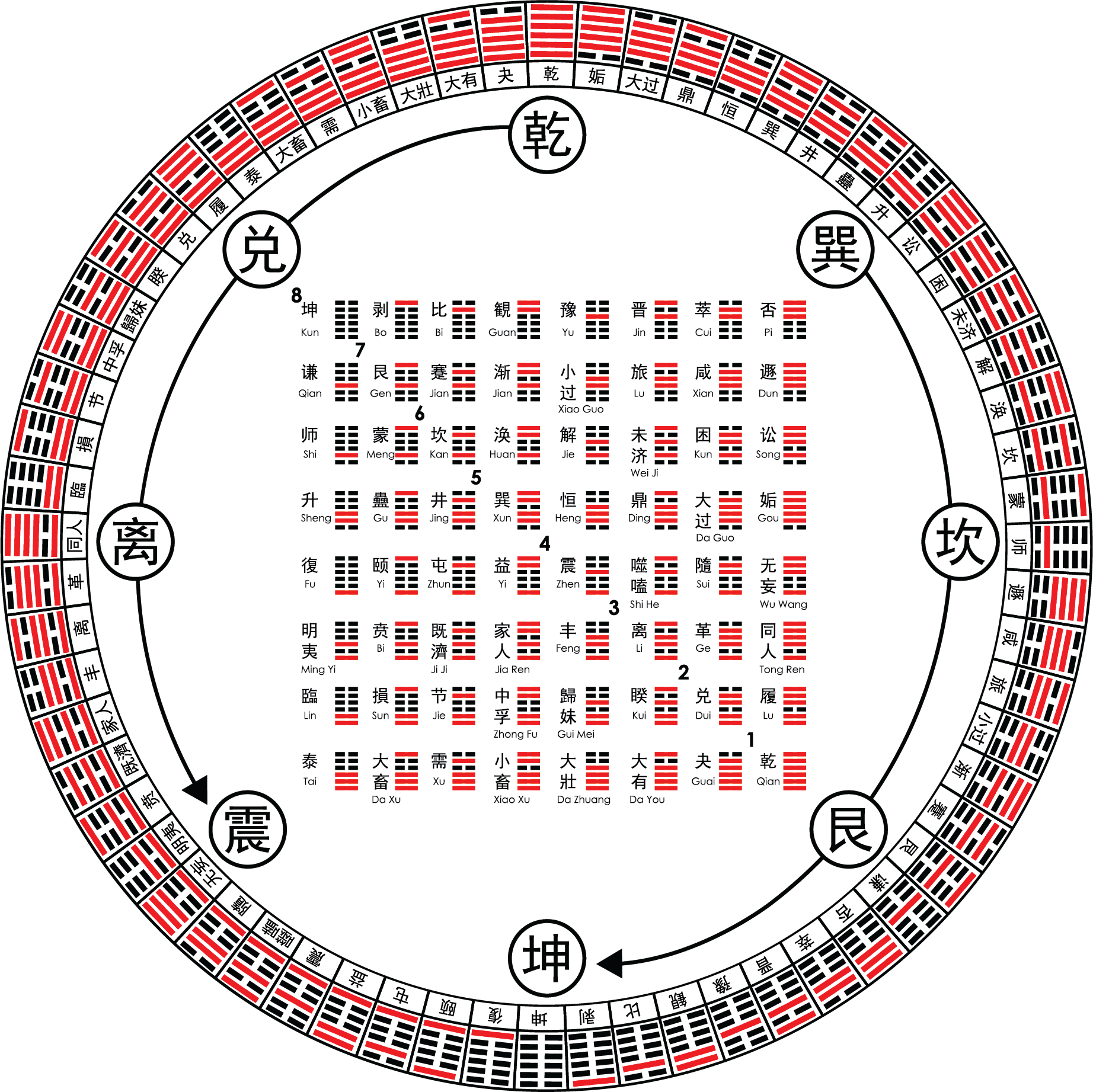
Find the corresponding Trigram to form the hexagram using the Early Heaven Trigram (EHT) Table.
Using the digit A, this is your Upper Trigram.
Using the digit B, this is your Lower Trigram.
Step 05: Determine the Moving Line
Using the dd/mm/yyyy, Add all the numbers together: d+d+m+m+y+y+y+y+x+x+x+x
The result will then be modulo by 6.
- If the remainder is 1–5, the moving line corresponds to that Yao position.
• If the remainder is 0, it is designated as line 6. Totals like 6, 12, 18, 24, and 30 all correspond to line 6 Yao.
Step 06: Interpret the Hexagam
You can refer to the Volume 2 and 3 of the book Yi Ding Decoded by Dean Chua for the Hexagram divination and the Classic Text.
In addition to the method presented here, the book Yi Jing Decoded by Dean Chua includes other approaches to divination that reflect different traditions and practices. Readers interested in understanding these methods in greater detail may refer to Yi Jing Decoded, where they are discussed within a broader context of study and application.